Connecting Research, Teaching, and Real-World Impact: The Marketing Area at Michigan Ross
The marketing area at Michigan Ross is one of nine faculty areas. The faculty in this area teach and conduct research to help businesses better serve customers — from what consumers value to how they behave throughout their purchase journeys and decision-making. Marketing research at Ross spans industries and often has an impact well beyond the classroom, shaping business strategy and, in some cases, informing public policy.
Impactful research and engaged teaching
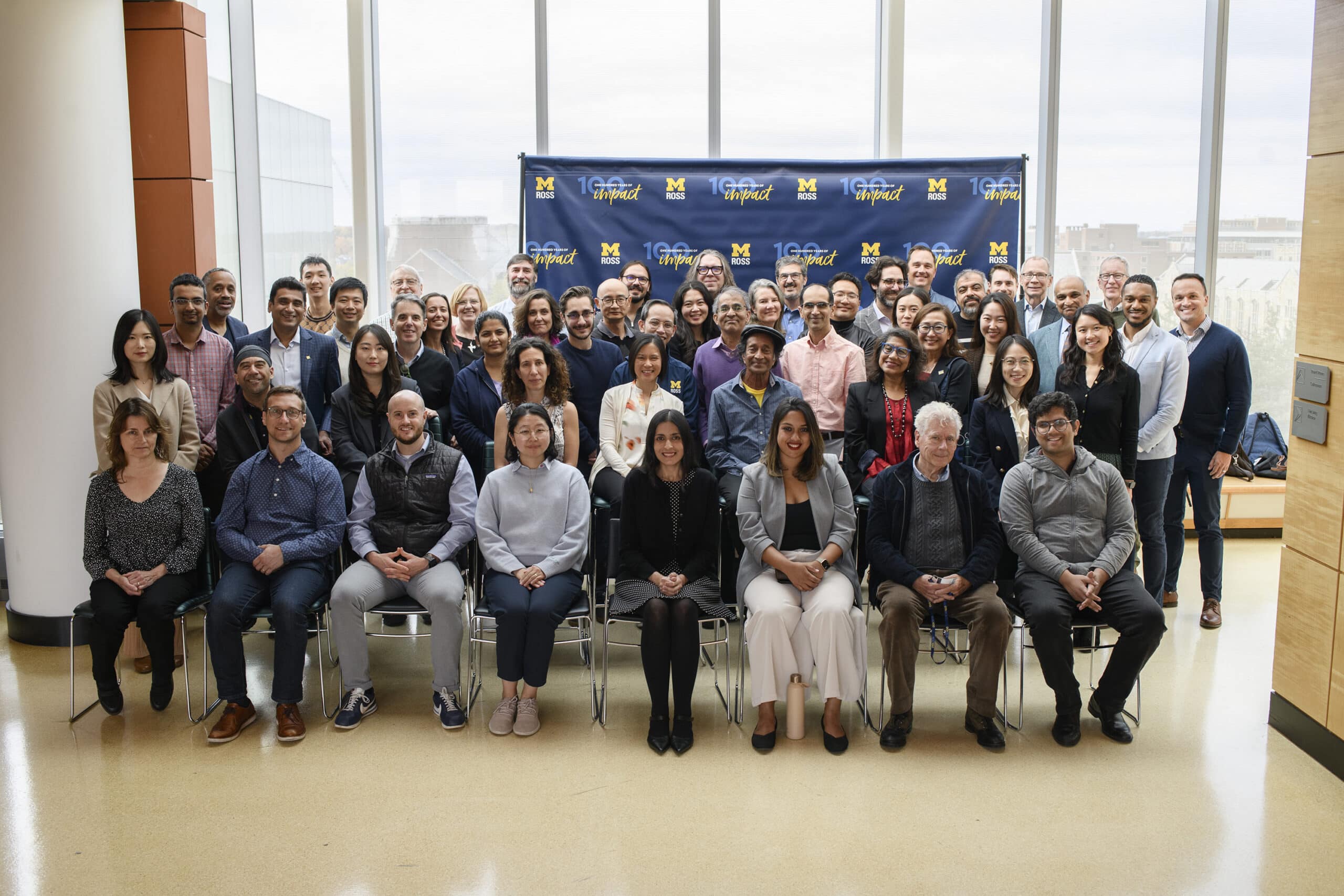
Anocha Aribarg, professor and area chair of marketing, leads the marketing academic area, which includes 15 tenure-track faculty members, 10 doctoral students, one clinical faculty member, and eight lecturers. Aribarg says the group often takes on research questions rooted in timely, real-world problems.
There are many examples of how marketing research can provide valuable insights for businesses. For example, Jessica Fong, associate professor of marketing, explored what happens when two digital sales platforms merge. Looking at data from before and after a pet-focused company merger, she found that consolidation can hurt consumers — evidence that supports concerns about market power and weakened competition. Because the work was relevant to ongoing debates about big-tech consolidation, it was cited in the 2023 Economic Report of the President for its insights into the downsides of platform mergers.
Aribarg noted that while finding a balance between conducting research and teaching can be difficult, it’s made easier by encouraging faculty to teach courses that connect to their research expertise and the questions they’re most excited to explore. For example, Scott Rick, associate professor of marketing, draws on findings from his own research to bring engaging examples of how consumers sometimes make irrational decisions into his consumer behavior courses.
“When faculty teach what they’re passionate about, that energy carries into the classroom and ultimately leads to a better experience for our students,” said Aribarg.
Collaborating with each other and across U-M
The marketing area comprises two types of researchers who often collaborate with each other and with other faculty across U-M.
- Quantitative modelers: Often trained in statistics, economics, and computer science, modelers are researchers who analyze real-world datasets using statistical methods, economic models, and cause-and-effect approaches.
- Behavioral researchers: Often trained in social and cognitive psychology and decision science, behavioral researchers use lab experiments to understand how people make decisions.
“At many schools, the quantitative and behavioral sides of marketing don’t blend,” said Aribarg. “One thing I’m proud of is that at Ross we try to work across paradigms because we believe in interdisciplinary, multi-method research.”
In one project, Professors of Marketing Yesim Orhun, a quantitative modeler, and Aradhna Krishna, a behavioral researcher, studied outcomes in quantitatively oriented courses and found that female students perform better when taught by female faculty. To understand why, they drew on behavioral evidence: female students reported feeling more engaged and encouraged, and were more likely to see female faculty as role models — factors that translated into stronger performance.
Marketing faculty at Ross also partner with colleagues in other schools and disciplines. Fred Feinberg, a professor of marketing with a joint appointment in the Department of Statistics, often collaborates with colleagues in Michigan Engineering. Feinberg brings those perspectives together to study product design and the questions that companies often struggle with. His work looks at how firms can design products that find a balance between what customers want and what’s actually buildable and cost-effective.
These projects show how Ross Marketing faculty at Ross connect different approaches and disciplines through research with real-world impact that helps businesses understand the consumer behavior that drives their performance outcomes.
A community that stays connected
Aribarg describes the marketing area as very community-focused and welcoming. Faculty and PhD students make time for informal lunches and social get-togethers. This makes it easy to swap ideas, stay up to date on each other’s work, and help new colleagues and students feel at home.
“We’re intentional about building community here — people don’t just work behind a closed door,” said Aribarg. “We make time to connect, share ideas, and help each other do better work.”
That support carries into the research process. Every other week, the area hosts ‘work-in-progress’ lunches, where faculty and PhD students can share early-stage ideas in a low-pressure setting and get constructive feedback.
“There’s a real ‘work it out together’ mindset,” Aribarg said. “We share what we’re learning, including challenges, so everyone benefits.”
Marketing faculty also connect across Ross through the Hosmer Interdisciplinary Lunch Series, a schoolwide forum where faculty from different areas present their work and exchange perspectives. Aribarg sees it as a chance to learn what colleagues outside marketing are exploring and spark new collaborations.
“When you spend time with colleagues outside your field, it can widen your research horizon,” Aribarg said. “If we want our work to have impacts beyond marketing, interdisciplinary collaboration is essential.”