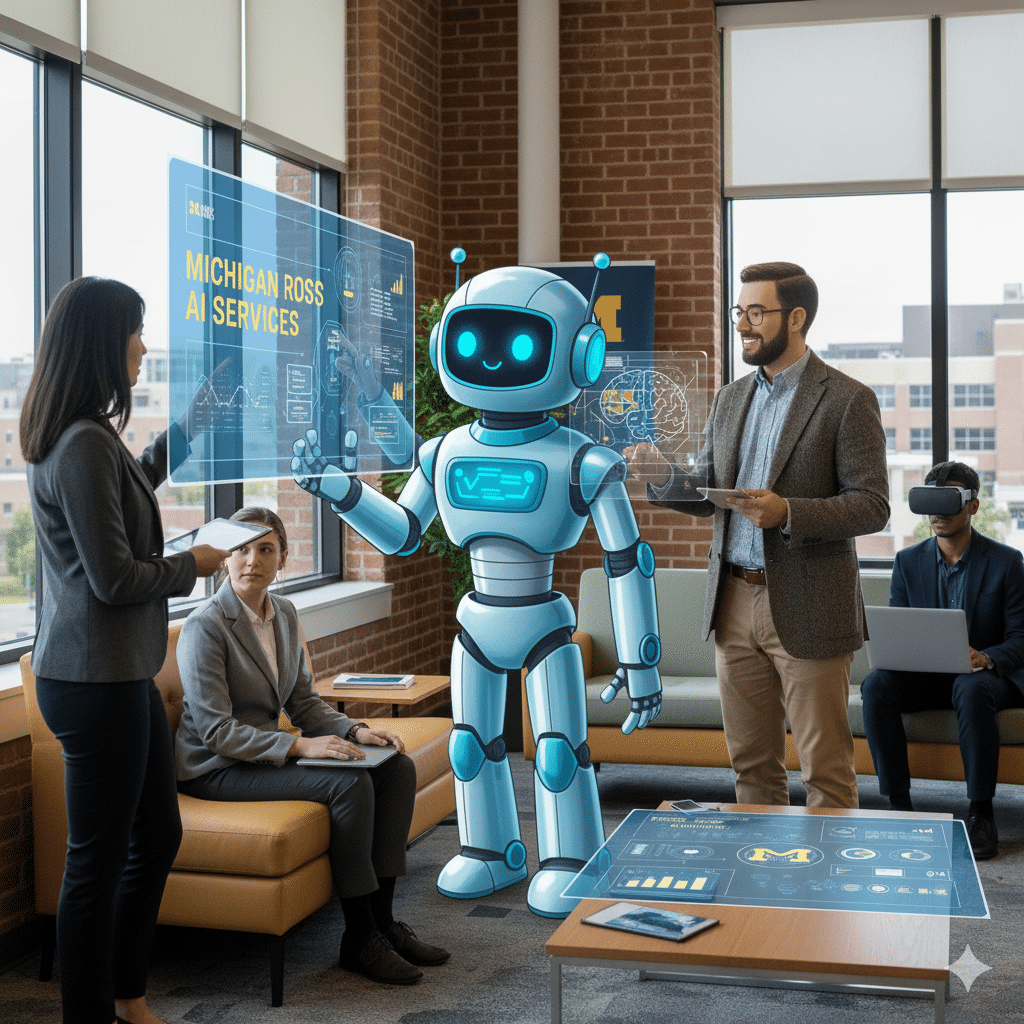
A light blue, friendly-looking AI robot stands in a modern office environment, holding up a transparent screen displaying "Michigan Ross AI Services." The robot has a glowing blue face, chest plate, and joints. Around it, several people in business attire are interacting with holographic displays showing charts and data.

Getting Started with AI Services at Ross

Generative artificial intelligence (GenAI) offers powerful opportunities for teaching, research, and process improvements, but using it responsibly requires careful planning. Before adopting AI tools, it’s important to think about what you want to achieve, how you’ll acquire the technology, and the ethical and practical considerations that come with it.

This guide outlines five key things to consider when working with AI—from defining your goals and understanding AI’s strengths and limitations, to ensuring data privacy, compliance, accessibility, and equity. By keeping these principles in mind, you can make informed decisions that maximize the benefits of AI while protecting academic integrity and the university community.

5 Things you should do when considering AI

  • Teaching
  • Research
  • Learning outcomes
  • Other (e.g., process improvements, etc.)
  • Develop a new resource using currently available U-M AI tools?
  • Buy it, with Ross IT assisting with the procurement.
  • Define the problem you are trying to solve. – AI is a tool, not a goal.
  • AI excels at pattern recognition, parsing information, and handling large datasets.
  • It is less reliable with nuanced judgment, up-to-date real-world context, or solving ill-defined problems.
  • AI systems rely on accurate, relevant, and clean data.  
  • Consider whether all your students and collaborators can access the AI tools you require or assign.
  • Learn about AI’s biases and how they may influence responses.

Last Updated on September 22, 2025